Monday, 22 January 2007
Monty Python: freedom from work
I was whiling away the hours until my block of flats' stairs have been painted white - no, I don't know why either - when I happened upon William Cook's review of one of Michael Palin's diaries in the Guardian, in which there was a wonderful note from the diary about John Cleese, Eric Idle and Monty Python's Flying Circus: "John and Eric see Monty Python as a means to an end - money to buy freedom from work".


Saturday, 20 January 2007
Armenian journalist Hrant Dink murdered
In 2005, Hrant Dink believed that:
I don't think I could live with an identity of having insulted them [Turks] in this country... if I am unable to come up with a positive result, it will be honourable for me to leave this country.In 2006, he stated that:
I will not leave this country. If I go I would feel I was leaving alone the people struggling for democracy...It would be a betrayal of them.On Friday the 19th of January 2007, Hrant Dink was murdered by nationalists - twice shot in the head - outside the office of his newspaper, Agos, which published in Armenian and Turkish and which, as Nicholas Birch noted in the Guardian,
was the fruit of his belief that only dialogue could resolve the bitter memories left by the mass murder of Ottoman Armenians during the first world war.On from Holland to Kurdistan, Vladimir van Wilgenburg remembered that,
Recently he also participated in the "democracy and peace initiative". The goal of this conference was to bring peace to Turkey and a solution for the Kurdish issue. Hrant Dink was a true defender of democracy.Nicholas Birch relayed the suspicion of former head of the Human Rights Association of Turkey, Akin Birdal, "who was himself shot and severely wounded in 1998 by suspected nationalists", that:
This was an organised attempt by those who want to destroy Turkey's European Union aspirations and cast Turkey into darkness.At Rasti, Mizgin argued that:
Turkey is making no effort to "come to terms with its past." It is still a fascist regime and it has no intention of changing. Even the EU knows this and not only goes along with Turkey, but enables it at every opportunity, and why not? Europe is the native home of fascism.This murder is one horrific part of a system of oppression of the whole of Turkish society. As relayed from CNN by Onnik Krikorian at Oneworld Multimedia,
He [journalist and friend Andrew Finkel] said that over the last 15 years, 18 Turkish journalists have been killed - making the country the eighth deadliest in the world for journalists in that period. He said that many of the deaths took place in the early 1990s "at the peak of the Kurdish separatist insurgency."Although I share Mizgin's disgust with the crime, I don't think blocking Turkey's accession will solve the problems; I still believe that the only way to take Turkey out of the military's hands in particular and nationalists' hands in general and put it in the hands of all of the citizens of Turkey is through the European Union. For updates on Hrant Dink's murder by Turkish nationalists, see Oneworld Multimedia (and from Holland to Kurdistan and Rasti).
He said killings, other attacks against journalists that don’t result in deaths, and the many cases of Turkish journalists facing criminal charges under "vague statutes" create a "chilling effect" among media workers.
Wednesday, 17 January 2007
Torture: practice, system, experience
"My worst moment as a lawyer" is P. Sabin Willett's razor-sharp analysis of the practice of torture and the creation of its victims and moving communication of the experience of torture and the system that practices it, which I got by way of East Ethnia. (It was given at the Newburyport Amnesty International (AI) meeting on the 5th of December 2006.)
Although entirely different in subject, I was somehow reminded of Lieutenant Colonel Tim Collins' talk to his troops before the invasion of Iraq, perhaps in its beseeching of justice, perhaps because the way Collins spoke expressed what a just war is supposed to be and how it is supposed to be conducted and how different that is from what Willett documents. (It was given at the Fort Blair Mayne camp in Kuwait on the 19th of March 2003.)
Different again, Marie Fatayi-Williams appealed for knowledge about her son Anthony, who went missing - killed - in the 7th of July bombings and for a turn away from violence and the spilling of innocent blood and towards peace. (Fatayi-Williams made her address in Tavistock Square, London on the 11th of July 2005.)
Although entirely different in subject, I was somehow reminded of Lieutenant Colonel Tim Collins' talk to his troops before the invasion of Iraq, perhaps in its beseeching of justice, perhaps because the way Collins spoke expressed what a just war is supposed to be and how it is supposed to be conducted and how different that is from what Willett documents. (It was given at the Fort Blair Mayne camp in Kuwait on the 19th of March 2003.)
Different again, Marie Fatayi-Williams appealed for knowledge about her son Anthony, who went missing - killed - in the 7th of July bombings and for a turn away from violence and the spilling of innocent blood and towards peace. (Fatayi-Williams made her address in Tavistock Square, London on the 11th of July 2005.)
Monday, 15 January 2007
Blog: Kosovo corrections; updates
I can only apologise and promise that the necessary corrections and updates have now been made and will continue to be made at the earliest opportunity. I lacked internet access for so long that the e-mail account that notifications of comments awaiting moderation went to cleared and when I aceessed it again, I had no idea anyone had tried to say anything. It was only today, when I was able to use the new blogger, which shows you in the post list which ones have comments that I found out.
When I did find out, too, it did not make for pretty reading: there were about a dozen corrections - some of them serious - and a dozen more updates. So, I've now been through and accepted all of the comments for publication - in my haste, even one advert, which I don't seem to be able to delete now - and changed or extended the posts where necessary. I'm including guides to the corrections and updates below and publishing this post on both samarkeolog and human rights archaeology.
Understandably, some people found it difficult to be patient, but I hope that these posts and their correspondent corrections and updates make clear that I am sincere in my efforts; put simply, I may be stupid and ignorant, but I'm not a bastard.
Before I list the general mistakes, I wish to highlight the most serious errors that I made:
When I did find out, too, it did not make for pretty reading: there were about a dozen corrections - some of them serious - and a dozen more updates. So, I've now been through and accepted all of the comments for publication - in my haste, even one advert, which I don't seem to be able to delete now - and changed or extended the posts where necessary. I'm including guides to the corrections and updates below and publishing this post on both samarkeolog and human rights archaeology.
Understandably, some people found it difficult to be patient, but I hope that these posts and their correspondent corrections and updates make clear that I am sincere in my efforts; put simply, I may be stupid and ignorant, but I'm not a bastard.
Before I list the general mistakes, I wish to highlight the most serious errors that I made:
- first, Bytycci, Poli and Frederic Gernstein (and elsewhere, Kosovar), were kind enough to correct me when I made the grave error of mistranslating the nickname Nazi, short for Nazim or Nazmi, as being a national socialist statement, tag or slogan; and,
- second, although I appear to have got the literal translation of graffiti demanding 'no church' correct, Anonymous, Kosovar and Bytycci corrected my interpretation of the site and of the semantic meaning of the translation, as it was not a protest at the politically-driven construction of an Orthodox church on university land nearby, but at plans to demolish the very school that the graffiti was written on and replace it with a church.
- on Human Rights Archaeology, Eric Gordy turned about a fieldwork note on graffiti in Ferizaj/Urosevac;
- in Decan/Decani WARchild nuanced a poster slogan;
- in Mitrovice/Mitrovica, Anonymous pointed out a mistranslation and/or over-interpretation of the "Motel Mitrovica" sign;
- in Peje/Pec, I was correct in what I said, but, through comments by Artan and Andras, I've worked out that when I identified Bula Zade Mosque by reference to another source, I mislabelled what was the Bath House Mosque and displayed that photograph instead;
- in Prishtine/Pristina, Han_Solo corrected my reading of a Communist monument and Kosovar corrected my mistranslation of the Ministry of Education as the Ministry of Archives; while
- in Prizren/Prizren, Anonymous and Vasilevs corrected a translation and in the process identify the site of the Orthodox Archbishopric.
- in Decan/Decani, Vasilevs opened up the question of whether members of the KLA were "soldiers" or "terrorists" and commented about Albanians (not) being Illyrians [which I had listed as a correction or clarification, but which I felt I ought to move (14/03/07) as some commentators were concerned it might appear that I meant that it was a correction];
- in Ferizaj/Urosevac, he appeared to question the origin of the name of the town; but,
- in Gracanice/Gracanica, he translated an inscription on a stone in the wall of the monastery and Marko added to the presentation of the CCCC slogan;
- in Mitrovice/Mitrovica, Anonymous contributed information about the history of the Roma house documented and Arber told an anecdote about the CCCC slogan;
- in Prishtine/Pristina, Bytycci nuanced the reading of a palimpsest of graffiti and Arber and Anonymous confirmed a translation (as did Kosovar), although, with a poor photograph in which a chimney was more prominent than the statue (and presumably in the context of all of the other errors I’ve made), Arber questioned whether the Hotel Victory did have a miniature Statue of Liberty on it (however, I can confirm that it does, if you can expand the photograph enough to see it);
- in Prizren/Prizren, Vasilevs challenged the description of the Albanian League of Prizren, then objected to the inscriptions on statues of Xhevat Berisha and Ismet Jashari; while
- I could only offer an inconclusive non-answer to Kate M's question about who the architect of the town's Sinan Pasha Mosque was.
Thursday, 11 January 2007
Pano Koutraphas: abandoned village, destroyed
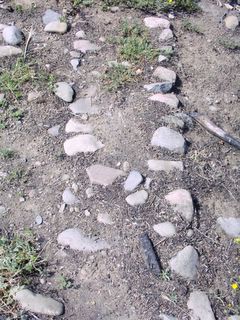
When I was having the argument with other international archaeologists about the destruction of Ayios Epiphanios, Pano Koutraphas was mentioned in passing, to explain Ayios Epiphanios's location. Thinking I had been talking about Koutraphas, one admonished me, 'Pano Koutraphas wasn't bulldozed - it just fell apart'. I hadn't said that Pano Koutraphas had been destroyed, although it had and I knew it had. As I recorded in my notes (emphasis added):
I clarified, 'I wasn't saying that Pano Koutraphas was bulldozed', then, half-unsure and half-unwilling to start a second argument and destroy my credibility, I "copped out", 'I know it just fell down.'Pano Koutraphas was a village of fifty Turkish Cypriots when the Troubles began (Goodwin, 1978: 459); now, apart from a few buildings visible towards the horizon, which could be part of other nearby settlements, Pano Koutraphas has been reduced to its foundations. Again, as I said in my notes:
When I copped out and concurred that ‘it just fell down’, I was made more aware, first, of just how easy compromising oneself and copping out is and, (self-servingly) second, of how the act of copping out may be professionally justified (or, perhaps, personally excused), as, had I insisted that Pano Koutraphas was bulldozed as well as Ayios Epiphanios, I believe I would have been utterly ignored.Apart from being iconic case studies of the treatment of Turkish Cypriot community cultural heritage in southern Cyprus, archaeologists' relationships with Ayios Epiphanios and Pano Koutraphas seem to me central to my examination of archaeologists' roles in conflicts.
It was arguments with other archaeologists about these places that made site inspection, documentation and presentation integral to my work. It would be great if these site blogs became arenas of discussion and debate, but, at the very least, they provide non-partisan, public documentation of some of the past history and current condition of the destroyed, abandoned villages like Pano Koutraphas, helping to establish their history and to challenge historical myths and lies.
Goodwin, J C. 1978: An historical toponymy of Cyprus. Nicosia: Jack C. Goodwin.
Ayios Epiphanios: abandoned village, destroyed
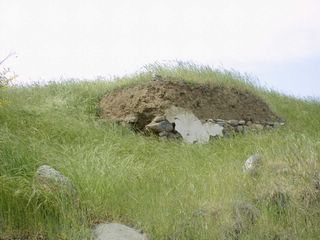
Ayios Epiphanios was one of the first places I visited as a "negative heritage tourist"; I and a couple of other archaeologists toured several sites, "mine" also including the twin villages of Kato and Pano Koutraphas. When I stated that the abandoned village of Ayios Epiphanios had been destroyed, some archaeologists agreed, but others vehemently denied it.
Those who denied that the village had been destroyed could not be convinced with the only evidence I had at the time, which was documentation by 'TRNC sources' (the northern administration's official narratives); these preliminary photographs are the first pieces of non-partisan evidence I have that I can use in the site's interpretation.
Of many, there are two sites Jack C. Goodwin (1978: 166) identified as Ayios Epiphanios that must not be confused. The first is a 'locale' half a mile north-west of Pano Phlasou, where there is a church also named after Ayios Epiphanios, but, otherwise, '[f]ields [and] olives; no habitation'. The second is a 'village' called 'Ayios Epiphanios-Solea' or 'Aybidfan' - or, according to Karaokcu (2003c), 'Aybifan' or 'Aybirfan' - half a mile north-west of Kato Phlasou.
In the village of Ayios Epiphanios, there is a church called Ayia Mavri; the village had had a population of '66(T [Turkish Cypriots])' at the time of the Troubles and had been 'the birthplace of Rauf Denktash, President of the so-called Turkish Federated State of Cyprus', whose 'fellow-villagers were transferred to the TA occup [Turkish army-occupied] part of Cyprus under UNFICYP escort in 1975' (Goodwin, 1978: 166).
I didn't see the name of the church displayed, but as the photographs clearly show (albeit buried) habitation, I can only assume that this is the village of Ayios Epiphanios. Reading the description of the site by Karaokcu (2003c - emphasis added), it fits exactly and is worth quoting at length:
There were no signs showing the village. There was no need for this, because during the 1960s, when the Turkish Cypriots were forced to migrate from this village due to the pressures imposed upon them this small, pretty village had been completely razed to the ground by the Greek Cypriots.As for the church, 'built by the Greek Cypriots while they were using the military camp' (Karaokcu, 2003c), this would complement and corroborate the idea that the bulldozed village was aggressively reshaped, as the "empty" land was refilled with military material, then Christianised, made Greek Cypriot (Orthodox).
Afterwards, the Greek Cypriots turned this area into a military camp and then later left this camp. In its place, all we found were abandoned military vehicles, exploded smoke grenades, barbed wire and trenches. There wasn't a single house in Aybifan. We even found it difficult to find the remains of the foundations of any houses.
Since, as Goodwin (1978: 166) noted, Denktash 'swore to return to his vill [village] one day, meaning at the time that he meant to retire back home', the Greek Cypriot nationalists' particular desire to destroy the leader of the enemy's birthplace and to leave him no home to retire to would add to their general desire to leave the enemy no village to return to and to erase the memory of their existence.
Goodwin, J C. 1978: An historical toponymy of Cyprus. Nicosia: Jack C. Goodwin.
Karaokcu, H. 2003c: "The present conditions of Turkish Cypriot villages in south Cyprus 3". Diplomatic Observer. Available at: http://www.diplomaticobserver.com/news_read.asp?id=838
(The quotes are original, although their formatting may have been changed to make them easy to read in a blog.)
Wednesday, 10 January 2007
Cyrus Cylinder: "human rights charter" propaganda
On PaleoJudaica, Jim Davila posted a list mail from Jona Lendering explaining that 'Cyrus was not the author of the first charter of human rights' and that that idea was created through a 'falsified translation - possibly created by followers of the late Shah'.
[Updated on the 18th of January 2007.]
I have to admit that I bought into the propaganda about the Cyrus Cylinder and repeated it in my DPhil research proposal. I was trying to show that 'universal moral entitlements [were] neither a Western, nor a recent, construction', citing Ashoka as an example, before I stated that 'it was Cyrus, in west Asia in the Sixth Century B.C.E., who set out the as yet first known "Charter of Freedom of Humankind"'.
Davila had already challenged inaccurate representations of the genuine article. Noting its image in the Lebanon Daily Star, which observed the artefact's convenience for the Shah 'to reawaken nationalism', Davila commented that, 'it still was an empire, with "hegemony" and "oppression" and all those other bad things we associate with imperialism today'.
After an article in the Persian Journal, which revealed the complexity of the myths surrounding the Cyrus Cylinder when it quoted the National Museum of Iran's Shahrokh Razmjou as saying that, '[people] feel strongly about it because it is about freedom and giving freedoms', Davila countered that:
The accurate translation of Fragment A and Fragment B of the genuine Cyrus Cylinder are available on Livius, prefaced with their role as both ancient and modern propaganda.
[Updated on the 18th of January 2007.]
I have to admit that I bought into the propaganda about the Cyrus Cylinder and repeated it in my DPhil research proposal. I was trying to show that 'universal moral entitlements [were] neither a Western, nor a recent, construction', citing Ashoka as an example, before I stated that 'it was Cyrus, in west Asia in the Sixth Century B.C.E., who set out the as yet first known "Charter of Freedom of Humankind"'.
Davila had already challenged inaccurate representations of the genuine article. Noting its image in the Lebanon Daily Star, which observed the artefact's convenience for the Shah 'to reawaken nationalism', Davila commented that, 'it still was an empire, with "hegemony" and "oppression" and all those other bad things we associate with imperialism today'.
After an article in the Persian Journal, which revealed the complexity of the myths surrounding the Cyrus Cylinder when it quoted the National Museum of Iran's Shahrokh Razmjou as saying that, '[people] feel strongly about it because it is about freedom and giving freedoms', Davila countered that:
The Cylinder doesn't promise the freeing of all slaves; that idea never would have occurred to anyone in antiquity. (You can read a translation of the whole thing here.) Still, I can see why the Mullahs don't like it: no terrorizing the populace; no detaining foreigners against their will; bringing relief to dilapidated housing (one thinks of Bam); honoring all religions.I would have to disagree with him that 'the idea [of the abolition of slavery] never would have occurred to anyone in antiquity':
- although it does not refer to anyone calling for total abolition and does not directly contradict Davila, in the sixth book of his Dialogues, Plato noted that, 'slavery of the Helots is approved by some and condemned by others; and there is some doubt even about the slavery of the Mariandynians at Heraclea and of the Thessalian Penestae'; however,
- in the first book of Politics, Aristotle presented a defence of slavery, then stated that, 'Others affirm that the rule of a master over slaves is contrary to nature, and that the distinction between slave and freeman exists by law only, and not by nature; and being an interference with nature is therefore unjust', which does show that 'the freeing of all slaves' had been thought of and advocated by some in antiquity.
The accurate translation of Fragment A and Fragment B of the genuine Cyrus Cylinder are available on Livius, prefaced with their role as both ancient and modern propaganda.
Monday, 8 January 2007
Koivunen: Turkey passport law
From Holland to Kurdistan's Vladimir van Wilgenburg was kind enough to paste as a comment on the 25th of December post, "Turkey: Koivunen ethnocide definition", a post from (what I can now confirm is Kristiina Koivunen's own blog), explaining that
It doesn't say much more than was already known (Turkey had already excused itself on grounds of 'state security'), but by Turkey specifying article 5 of the passport law to the Finnish Consulate, we do now know (if this can be parsed out from the technical violation of the ban on entry), that she was deported (or, if you prefer, she was given the ban that she was deported for breaking) for having 'a purpose of violating security and public order of Turkish Republic or to contribute or help those who violate or willing to violate'.
As far as I know, though, her work was with the Kurdish community, not the Kurdistan Workers' Party (PKK), so it would appear that Turkey regards the Kurdish community as one that violates Turkish security and public order by its mere existence.
The Foreign Ministry of Turkey told 22.12.2006 the Finnish Consulate in Ankara that I am not permitted to enter Turkey due to Turkey's Passport Law 5682 art 8 para 5.As Koivunen noted, she still hasn't had 'any written document' about her deportation, but she has found and published Turkey's passport law, under which she was deported, which I've reproduced above (from Vladimir van Wilgenburg's comment).
I haven't yet got any written document about my case.
This law is following:
People who are prohibited to enter Turkey:
Article 8 - 1. Tramps and Beggars;
2. Those who have mental or contagious diseases (those who would risk the general health and public order and visit with the purpose of treatment or change of climate for medical reasons either alone or with their legal guardians will be exceptional).
3. Those who are convicted or found guilty for one of the crimes which are considered reason for extradition of criminals as per relevant agreement or agreements, of which Turkey is a party;
4. Those who are deported from Turkey and are not allowed to return back;
5. Those who are discerned to have entered the country with a purpose of violating security and public order of Turkish Republic or to contribute or help those who violate or willing to violate;
6. Prostitutes and those perform business through urging women into prostitution, those who carry out white-slave trade and all types of smugglers;
7. Those who do not have enough money to afford their stay in Turkey and to return back and who cannot provide evidence that there are persons to accommodate them in Turkey or that they can work in Turkey in one of jobs which are not legally prohobited for foreign citizens.
It doesn't say much more than was already known (Turkey had already excused itself on grounds of 'state security'), but by Turkey specifying article 5 of the passport law to the Finnish Consulate, we do now know (if this can be parsed out from the technical violation of the ban on entry), that she was deported (or, if you prefer, she was given the ban that she was deported for breaking) for having 'a purpose of violating security and public order of Turkish Republic or to contribute or help those who violate or willing to violate'.
As far as I know, though, her work was with the Kurdish community, not the Kurdistan Workers' Party (PKK), so it would appear that Turkey regards the Kurdish community as one that violates Turkish security and public order by its mere existence.
Israel-Iran nuclear strike
On page 6 of the 6th of January edition, the Turkish Daily News published the most worrying article, reporting that there would be a "strike against Iran soon, UK magazine claims". 'The Spectator, a leading Conservative magazine in Britain, claimed in its latest issue that within the next 12 months the United States and/or Israel are likely to launch military strikes against Iran, adding that these strikes will "probably be nuclear."' It also claimed that, 'Iran might "dole out" small amounts of weapons-grade uranium to "terrorist groups" including Hamas, Hezbollah and Islamic Jihad before it makes its nuclear bomb.'
Apparently,
Tying this in with the reinterpretation of the lesson from the mass suicide at Masada, which denied the Romans the triumph (and triumphalism) of killing the last of the rebels from the Jewish Revolt of C.E. 66-73, Zerubavel (1994a: 87) read the reinterpretation as a narrative of 'the terrible oppression and victimization of the Jews that rendered death better than life and led them to choose suicide as the best alternative possible'. Zerubavel (1994a: 88) understood that 'Masada is no longer an abstract story from Antiquity but a vivid and powerful visual image that provides contemporary Israelis with a metaphor for their own situation: a small group of Jews living on top of an isolated cliff, surrounded by the desert and besieged by a powerful enemy, with no one to turn to for help'.
So, the state of Israel and, let us not forget, due to the long-foreshadowed US (and/or Israeli) action against it (yet again stated explicitly by the "senior Israeli source" in the Spectator article), the state of Iran both fear for their very survival and both are willing to 'do everything'; because both have made it clear that they are willing to do anything, both have justified fear (of the other) and both are now engaged in a race to ensure their survival at any cost, that cost being the "extinction" (mass destruction) of the other and, by ensuring the pre-emptive or retaliatory strike by the other, of themselves; except, if there is a war, both states will survive (although the governments may change) and the many, many victims will be the innocent civilian citizens of both states, whose governments believe they are protecting them. We can only hope that, in this grotesque, international game of chicken, in which the cars' owners are the states, but the people in the front seats are their citizens, someone pulls out.
Zerubavel (1994a: 90-91) also recorded '[t]he Holocaust counter-narrative claims that Israelis' tendency to see themselves as persecuted and victimized contributes to their own misuse of power within the context of the conflict with the Palestinians'. This also bears upon the present situation, insofar as it warns of the Israeli and Iranian states' ability to convince themselves that the use of nuclear weaponry could ever be morally justified; so, if Davis and Zerubavel are correct, we could see a war fought with nuclear weaponry within the first decade of the new millennium.
Zerubavel, Y. 1994a: "The death of memory and the memory of death: Masada and the Holocaust as historical metaphors". Representations, Number 45, 72-100.
Apparently,
A "senior Israeli source" told [Spectator writer Douglas] Davis that the issue at hand is "a threat to the survival of the state of Israel," and continued: "On that issue there can be no compromise. We are the product of the Holocaust and we will do everything to prevent another holocaust occurring in Israel. If the Americans do not act, then we will act. And that moment might be closer than people dare to imagine."Zerubavel (1994a: 80) observed that, between the 1940s and the 1960s, because of the weakness perceived in Holocaust victims' very victimhood, there was 'a reluctance to embrace the Holocaust as part of Israeli collective memory'; however, Zerubavel (1994a: 86) noted that, increasingly between the 1960s and the 1980s, after the Eichmann trial increased knowledge of the plight of Holocaust victims and the "Yom Kippur War" of 1973 increased identification with the victims, survival and extinction became the two "options" central to Israeli consciousness. For Zerubavel (1994a: 87), this explained why the Holocaust became the key event in Israeli thought, 'evoked as a paradigmatic event that helps explain the Jewish past and the Israeli present'.
Tying this in with the reinterpretation of the lesson from the mass suicide at Masada, which denied the Romans the triumph (and triumphalism) of killing the last of the rebels from the Jewish Revolt of C.E. 66-73, Zerubavel (1994a: 87) read the reinterpretation as a narrative of 'the terrible oppression and victimization of the Jews that rendered death better than life and led them to choose suicide as the best alternative possible'. Zerubavel (1994a: 88) understood that 'Masada is no longer an abstract story from Antiquity but a vivid and powerful visual image that provides contemporary Israelis with a metaphor for their own situation: a small group of Jews living on top of an isolated cliff, surrounded by the desert and besieged by a powerful enemy, with no one to turn to for help'.
So, the state of Israel and, let us not forget, due to the long-foreshadowed US (and/or Israeli) action against it (yet again stated explicitly by the "senior Israeli source" in the Spectator article), the state of Iran both fear for their very survival and both are willing to 'do everything'; because both have made it clear that they are willing to do anything, both have justified fear (of the other) and both are now engaged in a race to ensure their survival at any cost, that cost being the "extinction" (mass destruction) of the other and, by ensuring the pre-emptive or retaliatory strike by the other, of themselves; except, if there is a war, both states will survive (although the governments may change) and the many, many victims will be the innocent civilian citizens of both states, whose governments believe they are protecting them. We can only hope that, in this grotesque, international game of chicken, in which the cars' owners are the states, but the people in the front seats are their citizens, someone pulls out.
Zerubavel (1994a: 90-91) also recorded '[t]he Holocaust counter-narrative claims that Israelis' tendency to see themselves as persecuted and victimized contributes to their own misuse of power within the context of the conflict with the Palestinians'. This also bears upon the present situation, insofar as it warns of the Israeli and Iranian states' ability to convince themselves that the use of nuclear weaponry could ever be morally justified; so, if Davis and Zerubavel are correct, we could see a war fought with nuclear weaponry within the first decade of the new millennium.
Zerubavel, Y. 1994a: "The death of memory and the memory of death: Masada and the Holocaust as historical metaphors". Representations, Number 45, 72-100.
Talat-Turkish military tension
On page 3 of its newspaper for the 6th of January, the Turkish Daily News relayed that "Talat downplays tension with Turkish military". The article was about the Ledra Street-Lokmaci Gate crossing, the supposed opening of which was one of the leading issues in the Cypriot newspapers when I arrived on the island a year ago. The opening of the crossing point doesn't particularly interest me (although it would make my life, like everyone else's, easier, especially once I've moved north), but something 'Turkish Cypriot President Mehmet Ali Talat' said does.
If we privileged nationalist readings, we would assume that Talat meant that the supposed Greek (Cypriot) threat was too great to allow internal divisions that might weaken Turkish (Cypriot) defences; however, I think that may be generous to the nationalists and may be unfair to the Turkish Cypriot community and their leader. I think it's possible to read the meaning that the Turkish Cypriots - the Turkish Cypriot community, the Turkish Cypriot administration - don't have the luxury to disagree with the Turkish (Cypriot) military.
I believe that reading is possible because of the situation in northern Cyprus. In an interview with David Jessel on the BBC's Hardtalk programme on the 13th of July 2005, an admittedly imperfect source, Greek Cypriot President Tassos Papadopoulos, asked rhetorically,
Talat also denied claims that there was a disagreement between him and Lt. Gen. Hayri Kivrikoglu, commander of the Turkish Cypriot peacekeeping force. "I don't think we can have such a luxury," he said.I don't know what relationship the "Turkish Cypriot peacekeeping force" has with the civilian administration and the occupying army, but I suspect it's (kept) closer to the Turkish army than the Turkish Cypriot administration, particularly given the Turkish Daily News itself abbreviated it to '[the] Turkish military'.
If we privileged nationalist readings, we would assume that Talat meant that the supposed Greek (Cypriot) threat was too great to allow internal divisions that might weaken Turkish (Cypriot) defences; however, I think that may be generous to the nationalists and may be unfair to the Turkish Cypriot community and their leader. I think it's possible to read the meaning that the Turkish Cypriots - the Turkish Cypriot community, the Turkish Cypriot administration - don't have the luxury to disagree with the Turkish (Cypriot) military.
I believe that reading is possible because of the situation in northern Cyprus. In an interview with David Jessel on the BBC's Hardtalk programme on the 13th of July 2005, an admittedly imperfect source, Greek Cypriot President Tassos Papadopoulos, asked rhetorically,
Is Mr. Talat authorised, to talk about the withdrawal of the Turkish army, about the cessation of the occupation, about all the things that Turkey decides and not Mr. Talat, who admittedly, said, publicly, in a meeting, "sorry, I had agreed to open this roadblock, but the military doesn't allow me to"?In other news, the Turkish Daily News also published a story on page 4 about the "Italian transgender MP to champion gay rights in Turkey, Muslim world". Vladimir Luxuria came across well - committed, but aware that if she were 'to engage in "gay colonialism"' it would undermine, rather than further, her and others' just campaign. Just last night having had local friends jokingly admonish me that, 'there are no gays in Turkey', I couldn't suppress a smile when I read that 'Luxuria said: "[In the Muslim world] in schools, work, and even in religious places men stay with men and women with women. There are even more opportunities than in our country [Italy]. But it is all shrouded in silence."' It's a point very quickly and cleanly scored, but I know people who'll feel really threatened by that and get very defensive.
Subscribe to:
Posts (Atom)

 Posts
Posts


